


Artificial Intelligence (AI) remains the dominant investment theme, but questions persist about valuation, risk management, and long-term sustainability.
Enduring Financial Technology Theories
We recently audited Professor Carlota Perez’s 2002 seminal book, Technological Revolutions and Financial Capital: The Dynamics of Bubbles and Golden Ages. This classic analyzes the evolving relationship between financial capital and production capital across technology cycles. Her work offers a useful framework for understanding why much broader economic gains often follow periods of speculative excess.
Perez is one of the world’s most influential thinkers on technology, innovation, and long-term economic cycles. She argues that every major technological revolution typically follows a four-phase progression, shaped by the interaction between financial capital, which accelerates early experimentation, and production capital, ultimately embedding new technologies into the real economy.
The Four Phases of a Technological Revolution
| Phase | Characteristics |
| (1) Irruption | Disruptive technologies emerge, sparking innovation and early opportunities. |
| (2) Frenzy | Capital floods the sector amid “must-own” narratives and soaring expectations. |
| Turning Point | Speculation fades as reality sets in, and markets correct. |
| (3) Synergy | Broad adoption drives productivity and genuine economic transformation. |
| (4) Maturity | Growth stabilizes as technology becomes standardized and widely integrated. |
Perez departs from more traditional economic cycle models by suggesting that these revolutions unfold over long arcs of 40 to 60 years, similar to extended hype cycles that drive structural development across industries.
The Lifecycle of a Technological Revolution
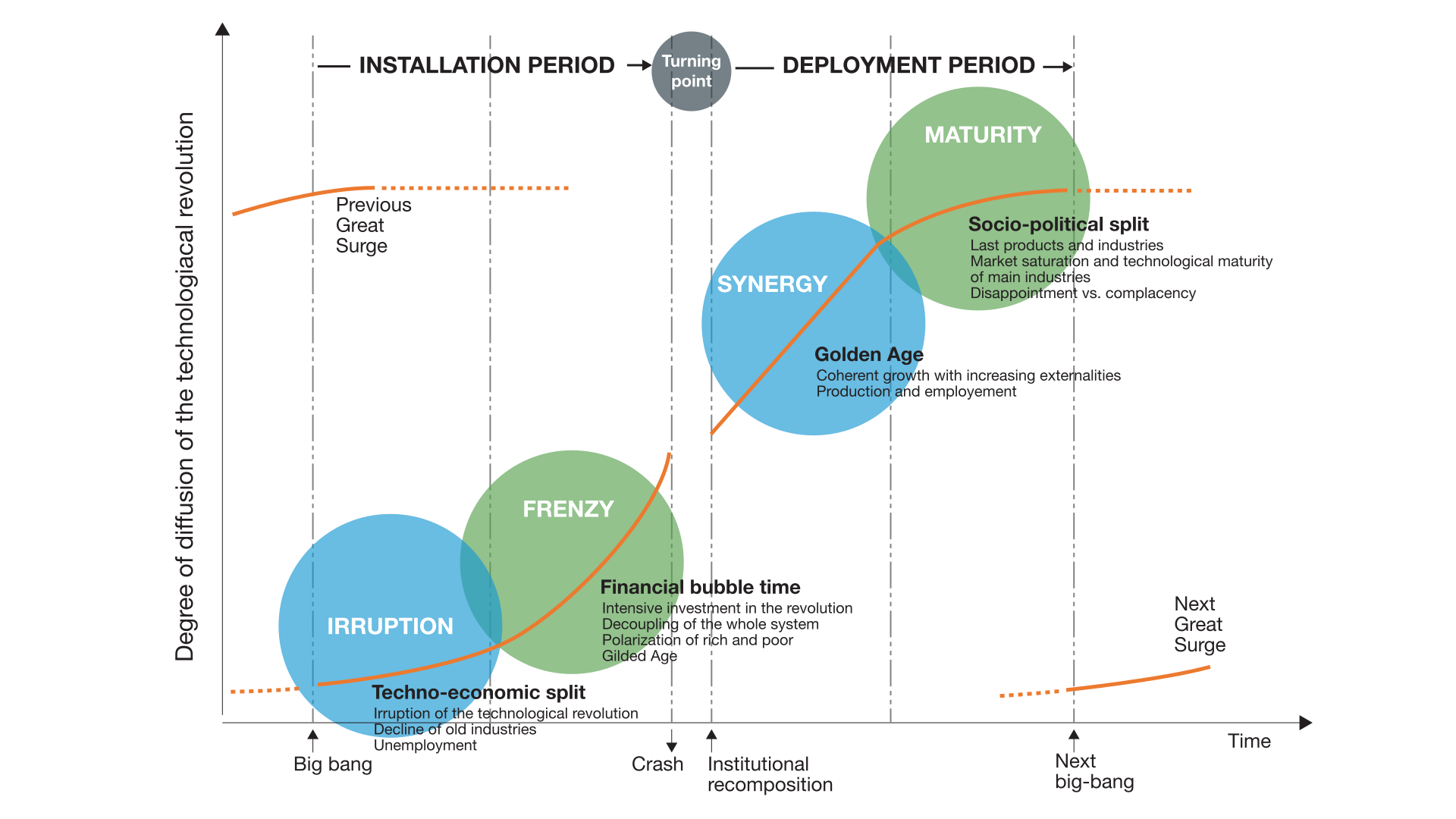
Examining the history of previous revolutions, she identified three recurring patterns. First, meaningful shifts in market economies tend to occur through technological revolutions rather than gradual change. Second, the early decades are experimental and often dominated by financial activity and speculation. Third, the later decades are production-centered, with clearer direction and broader societal benefit. It is during these later stages that the full economic potential of each revolution is typically realized.
AI in Focus
Perez emphasizes that a single breakthrough does not define a technological revolution, but by an economy-wide transformation in how industries operate. She contends that speculative phases, even bubbles, often play a necessary role by accelerating capital formation and scaling new technologies.
Viewed through this lens, past periods of innovation-driven exuberance, including those preceding the financial crisis, provide useful context for today’s AI landscape. Headlines are increasingly questioning whether we are in an AI bubble, reflecting understandable concerns about stretched valuations, concentrated leadership, and the extraordinary flow of capital into a narrow group of companies.
Using Perez’s framework as a lens for evaluating today’s market, we see evidence that the AI cycle is transitioning from the late Frenzy phase toward the early Turning Point. Enthusiasm remains elevated, yet concerns around capital discipline, sustainable profitability, and long-term value creation are rising. These tensions mirror current headlines, with excitement about AI’s transformative potential sitting alongside unease about whether expectations have outpaced fundamentals. The most economically productive phase of a technological revolution, often described as the “golden age,” typically comes after the Turning Point rather than during the speculative frenzy itself. This is the phase when deployment broadens, productivity gains diffuse across sectors, and the benefits of new technologies become embedded in everyday economic activity.
The Current Landscape
Today’s AI environment already shows early signs of this transition. We are seeing rapid productivity improvements in areas such as data processing, workflow automation, and operational efficiency. At the same time, meaningful disruption is emerging, including pressure on entry-level roles and shifting skill requirements. These dynamics are consistent with an economy adjusting ahead of a wider adoption phase.
From an investment standpoint, this transition period is often marked by increased dispersion, leadership shifts, and mispricing. It reinforces why selective, bottom-up investing and valuation discipline become particularly important, as the future winners of the AI cycle may differ materially from the leaders of the frenzy phase.
Incorporating Perez’s Framework into Active Investing
Active, long-term investors can elicit value in using Perez’s framework to contextualize market behavior, but not to time the markets. They can build on her insight that past cycles offer valuable lessons, provided investors look beyond popular narratives.
Active investors take a broad view of how and where AI creates economic value. However, many investors approach the theme too narrowly, concentrating primarily on AI enablers, such as hardware, semiconductor, and infrastructure companies, which have dominated the narrative. These firms play an essential role, but their valuations often embed very high expectations that imply near-perfect execution.
This is where rigorous fundamental research becomes essential. It helps separate genuine and durable return improvement from enthusiasm-led multiple expansion. It also allows investors to identify a wider set of AI beneficiaries, particularly among mid- and small-cap companies globally, where operational discipline is improving, and the market has not fully recognized the strength of the underlying fundamentals.
How An Active Investment Approach Can Adapt Across Stages of the AI Cycle
- Irruption Stage — Emerging Franchise Opportunities
Invest selectively in disruptive firms with viable profit models or credible paths to profitability, embracing asymmetry while remaining grounded in fundamentals. - Frenzy Stage — Participate with Discipline
Maintain exposure across the value chain but avoid overpaying. Rotate positions as valuations stretch and step aside before excesses unwind. - Turning Point and Synergy Stages — Focus on Substance
Prioritize companies with sustainable profits and genuine value creation, particularly those that leverage new technologies to enhance their existing operations. Seek dislocated value where durability and earnings potential are underestimated as the golden age of deployment begins to emerge. - Maturity Stage — Quality and Consistency
Hold resilient, high-quality companies at reasonable valuations as the technology becomes widely integrated and growth normalizes.
Lessons from History: When Innovation Meets Speculation
We caution against investor complacency at any point in the cycle. Timing markets is difficult, but properly pricing and structuring risk remains critical to long-term outcomes. History does not necessarily repeat, but it often sings a familiar tune.
During the telecom bubble of the early 2000s, equipment makers extended billions in vendor financing to help customers purchase their products. Many of these artificial sales collapsed once genuine demand failed to materialize. In parallel, capacity-swap “triangle” deals involving firms such as Global Crossing and Qwest were used to inflate revenues through reciprocal fiber-capacity transactions that had little real economic substance.
While today’s AI leaders are fundamentally stronger businesses, these historical parallels serve as a reminder that speculation can still distort value, even in the context of genuinely transformative technologies. Investors who lived through 1997, 2001, or 2007 will recognize familiar patterns and apply those lessons in capital allocation.
Key Takeaways
AI appears to be following a familiar pattern of innovation, speculation, correction, and eventual maturity. Parts of the ecosystem remain richly valued, but the underlying technology is genuinely transformative. The most productive and economically impactful phase of the revolution, the “golden age,” typically follows the Turning Point rather than the speculative peak. Beneficiaries are likely to emerge both upstream and downstream of AI model creators as the deployment of AI models broadens. Capital discipline and sustainable profitability will distinguish long-term winners from short-lived enthusiasm. Periods of transition tend to create dispersion, leadership change, and mispricing, reinforcing the role of selective, bottom-up active management.
Understanding where we might sit within the bubble-to-deployment cycle can help frame these concerns. However, navigating such environments ultimately depends on discipline and process. Active investors with a long-term perspective rely on thorough research and a balanced approach to guide asset allocation, portfolio construction, and risk management when speculation is high.
Discover more about:
Related Content

More Insights

Real Estate Market Recap: Trends, Challenges, and What Comes Next

Beyond the Hype—Building Smarter Private Credit Portfolios

Structural Forces Are Driving the Current Investment Environment

Key Principles of the ETF Execution Protocol

Finding Opportunity Amid Imbalance: 2026 Market Outlook